
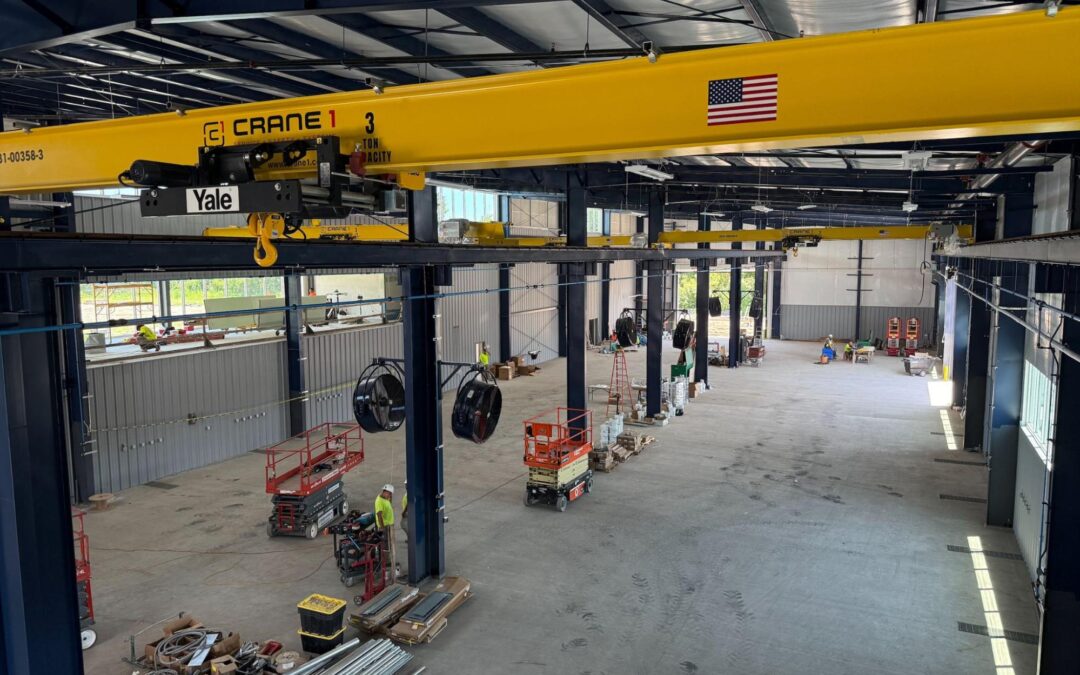
A full-service overhead crane provider handles design, installation, inspection, repair, and eventual replacement under one relationship, while a pure equipment supplier typically hands off everything after the sale.
Most facilities searching for a “reliable overhead crane supplier” are actually looking for something broader than a piece of equipment. They want a partner who can design it, install it, keep it compliant, repair it when something breaks, and eventually modernize or replace it, all without starting from scratch with a new vendor at every stage. That distinction, supplier versus full-service provider, matters more to cost and safety over time than almost anything on the spec sheet.
This guide explains the difference, why fragmented supply chains create risk that doesn’t show up until something goes wrong, and how to tell whether a company calling itself a “supplier” actually covers the full equipment lifecycle.
How to Tell If a “Supplier” Is Actually Full-Service
A few direct questions separate the two:
- Do they employ their own field service technicians, or subcontract that work out?
- Do they perform inspections themselves, using their own qualified inspectors?
- Do they maintain a documented history of repairs and inspections for each piece of equipment over time?
- Can they service brands other than their own, or only equipment they manufactured?
- Do they have a physical service presence in your region, or would you be their first customer there?
What a Pure Equipment Supplier Does
A pure equipment supplier designs, manufactures, or sells overhead cranes and hoists. Their relationship with a facility is often transactional: a crane is specified, built or sourced, delivered, and installed, usually by a separate contractor. Once the equipment is running, ongoing inspection, maintenance, and repair typically fall to whichever local service company the facility hires next, often with little visibility into how the equipment was originally specified or installed.
This isn’t a flaw in every case. For a straightforward, one-time equipment purchase, a pure supplier relationship can work fine. The risk shows up later, when the facility needs a second vendor to service equipment they didn’t build, working from documentation that may be incomplete or missing entirely.
What a Full-Service Provider Adds
A full-service overhead crane provider carries a facility through the entire equipment lifecycle under one relationship: engineering review and specification, installation and commissioning, load testing and initial inspection, ongoing compliance inspection, repair when something fails, and eventual modernization or replacement as the equipment ages. The same company that installed the crane is the one with the repair history, the inspection records, and the context to know whether a given failure is routine or a sign of something bigger.
Design and specification
Getting capacity, span, lift height, and duty cycle right at the outset determines how well a crane fits the job for the next 20 to 30 years. A provider involved from the design stage carries that context forward into every service call that follows.
Installation and commissioning
Proper installation, load testing, and initial inspection set the baseline every future inspection gets measured against. A provider who handles this step firsthand starts every crane’s documented history in the same place.
Ongoing inspection and compliance
OSHA 29 CFR 1910.179 and the applicable ASME B30 standards require regular inspection by a qualified person. A provider running these inspections themselves, rather than outsourcing them, can flag a recurring deficiency the moment a pattern starts, not months later when someone finally compares two separate reports.
Repair and preventive maintenance
A provider who both installed the equipment and handles its preventive maintenance can tell the difference between a one-off failure and the start of a costly pattern, because they have the full repair history in one place instead of scattered across vendors.
Modernization and eventual replacement
Every crane eventually reaches a point where repair, modernization, or replacement becomes the right call. A provider with a documented history of the equipment can make that recommendation on evidence, not guesswork, instead of starting the evaluation from zero.
Why Fragmented Supply Chains Create Risk
When design, installation, inspection, and repair are split across separate vendors, accountability splits with them. A warranty dispute becomes a conversation about whose scope the failure falls under. An OSHA audit becomes a scramble to track down records from three different companies, some of which may no longer exist or may not return calls. A repair technician working on equipment they’ve never seen before has to start every visit by re-learning a crane’s history instead of building on it.
None of this shows up on a quote. It shows up later, in downtime, in documentation gaps, and in decisions made without the context a single, continuous provider would have had on hand.
How CRANE 1 Approaches the Full Lifecycle
CRANE 1 carries facilities through the full lifecycle of their overhead crane equipment under one relationship. Our new crane solutions team handles design, specification, and installation. Our own qualified inspectors perform compliance inspections rather than subcontracting that work out, and our asset management program keeps a documented history of every asset’s condition and repair spend over time.
Our repair services and preventive maintenance programs cover all major crane and hoist brands, not just equipment we installed ourselves, and our Customer Assessment Program gives facilities an objective, documented read on where each crane stands and what it needs next. Contact CRANE 1 to talk through what full lifecycle support would look like for your facility.
Frequently Asked Questions
Q.What’s the difference between a crane manufacturer and a full-service crane provider?
A manufacturer designs and builds equipment, sometimes handing off installation and service to third parties. A full-service provider carries that equipment through its entire lifecycle, design, installation, inspection, repair, and eventual modernization or replacement, under one relationship.
Q.Do I need a different company for installation than for ongoing maintenance?
No, and keeping both under one provider reduces documentation gaps and accountability confusion. CRANE 1 provides installation and ongoing maintenance as part of the same relationship.
Q.What is asset management for overhead cranes?
It’s the ongoing tracking of an asset’s repair history, inspection records, and deficiency trends over time. CRANE 1’s asset management program makes patterns visible before they become budget or safety problems.
Q.How often does an overhead crane need to be inspected?
OSHA 29 CFR 1910.179 and the corresponding ASME B30 standards define frequent and periodic inspection intervals based on service classification and duty cycle. A qualified inspection provider can confirm the correct schedule for your specific equipment.
Q.Does CRANE 1 provide new crane installation and ongoing maintenance under one contract?
Yes. CRANE 1 covers new crane installation, inspection, repair, and preventive maintenance as one continuous relationship. Contact us to discuss your facility’s equipment.