
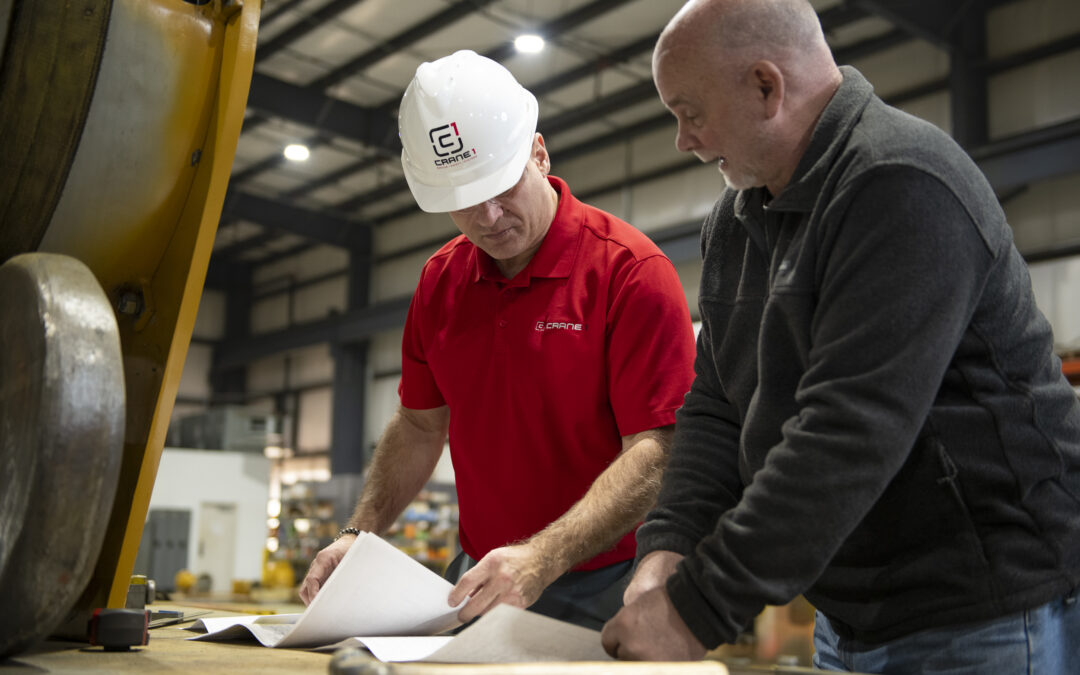
A reliable overhead crane supplier can document OSHA and ASME B30 compliance, service multiple crane and hoist brands, and support your equipment through its full lifecycle, from installation through inspection, repair, and eventual replacement.
Ask around for a “reliable overhead crane supplier” and you’ll get a dozen different answers, because the term covers a lot of ground. Some companies manufacture cranes and stop there. Some service and inspect equipment they didn’t build. Some do both. Facility managers rarely have an easy way to tell these apart until something goes wrong: a part that takes 12 weeks to arrive, an inspection report nobody can produce, a warranty dispute between the manufacturer and the installer.
This guide is a practical checklist for evaluating any overhead crane supplier, whether you’re buying new equipment, sourcing parts, or lining up ongoing service. It’s the same set of questions our own team gets asked on sales calls, laid out so you can use it on anyone you’re considering.
Documented compliance with OSHA and ASME B30 standards
A reliable supplier should be able to produce documentation showing their equipment and service work meet 29 CFR 1910.179 (OSHA’s overhead and gantry crane standard) and the relevant ASME B30 volumes, B30.2 for top-running bridge cranes, B30.16 for underhung hoists, B30.11 for monorails. If a supplier can’t explain which standards apply to your equipment, that’s a sign to keep looking.
CMAA classification knowledge
The Crane Manufacturers Association of America (CMAA) assigns duty-cycle classifications (A through F) that determine how a crane should be designed and rated for your specific application. A supplier who can walk you through where your equipment falls on that scale, and why, understands your operation, not just their catalog.
Multi-brand service capability
A supplier tied to one manufacturer’s product line has a built-in incentive to recommend that line, whether or not it’s the right fit. Look for a provider who services all major crane and hoist brands, which usually signals they’re recommending equipment based on your application rather than their own inventory.
In-house parts inventory and realistic lead times
Ask what’s actually stocked versus what has to be special-ordered, and get a real number for lead time on the parts you’re most likely to need. A supplier who stocks OEM and OEM-compatible parts on service vehicles can often turn around a repair in a single visit; one who doesn’t may leave a crane down for weeks waiting on a part.
In-house, qualified inspectors
Inspection is where documentation gaps show up most often. Ask whether inspections are performed by the supplier’s own qualified personnel or subcontracted out, and whether the reports categorize deficiencies by severity in a way that holds up under an OSHA or insurance audit.
Coverage across the full equipment lifecycle
A crane’s needs change over its 20 to 30 year service life: design and specification, installation and commissioning, ongoing inspection, eventual modernization or repair vs. replacement. A supplier who only covers one segment of that lifecycle forces you to manage multiple vendors and multiple sets of documentation. One who covers new installation, repair, and preventive maintenance under one contract eliminates that handoff risk.
An asset management system, not a filing cabinet
Ask how repair history, inspection records, and deficiency trends are tracked over time. A supplier with a structured asset management program can show you the pattern behind a crane’s repair spend before it becomes a budget problem. A supplier without one is asking you to remember it yourself.
Real emergency response, not a call center
“24/7 support” means different things to different companies. Ask what actually happens when you call at 2 a.m. on a Sunday: who answers, how fast a technician is dispatched, and whether that commitment is backed by a nationwide network of service locations or a single regional office.
Questions to Ask Before You Sign Anything
Bring these directly to any supplier you’re evaluating:
- Can you provide OSHA and ASME B30 compliance documentation for the equipment you’re proposing?
- Are your inspectors employed directly by your company, or subcontracted?
- What’s your average parts lead time for the brand and model I currently have?
- Can one contract cover installation, inspection, and ongoing maintenance, or will I need separate vendors for each?
- What’s your average emergency response time in my area, and how is that tracked?
- How do you document and share repair and inspection history over time?
Why the Wrong Answer Costs More Later
A fragmented supply chain, one company for design, another for installation, a third for service, tends to create gaps that only surface during an audit, an incident investigation, or a warranty dispute. Nobody owns the full picture, and documentation gets split across vendors who don’t talk to each other. A single, qualified partner who can carry a crane through its full lifecycle removes that risk by design, not by coincidence.
How CRANE 1 Meets This Standard
CRANE 1 services all major crane and hoist brands, stocks OEM and OEM-compatible parts on our service vehicles, and employs our own qualified inspectors rather than subcontracting compliance work out. Our Customer Assessment Program and asset management program give facilities documented, ongoing visibility into equipment condition, and our new crane solutions, repair services, and preventive maintenance programs mean one contract can carry your equipment from installation through its full service life.
We operate 24/7/365 with technicians dispatched from locations across the country, not a single regional office. Contact CRANE 1 to walk through this checklist against your own facility’s needs.
Frequently Asked Questions
Q.What should I look for in an overhead crane supplier?
Look for documented OSHA and ASME B30 compliance, CMAA classification knowledge, multi-brand service capability, in-house parts and inspectors, coverage across the full equipment lifecycle, a structured asset management system, and real 24/7 emergency response backed by a nationwide network.
Q.Are overhead crane manufacturers and overhead crane service providers the same thing?
Not always. Some companies only manufacture and sell equipment, leaving installation, inspection, and repair to third parties. Others, including CRANE 1, provide both new equipment solutions and the ongoing service, inspection, and maintenance that keep a crane compliant and running over its full service life.
Q.How do I verify a crane supplier is OSHA and ASME compliant?
Ask them directly for documentation tied to 29 CFR 1910.179 and the relevant ASME B30 volume for your equipment type, and ask to see a sample inspection report. A supplier confident in their compliance program will have this ready without hesitation.
Q.Can one company handle both new crane installation and ongoing maintenance?
Yes, and it’s worth prioritizing suppliers who can. CRANE 1 provides new crane installation, repair, preventive maintenance, and inspection under a single relationship, which keeps documentation and accountability in one place.
Q.How do I find a reliable overhead crane supplier near me?
Run any candidate through the checklist above, and prioritize a provider with a documented nationwide service network rather than a single local office. Find your nearest CRANE 1 location or contact us directly.